
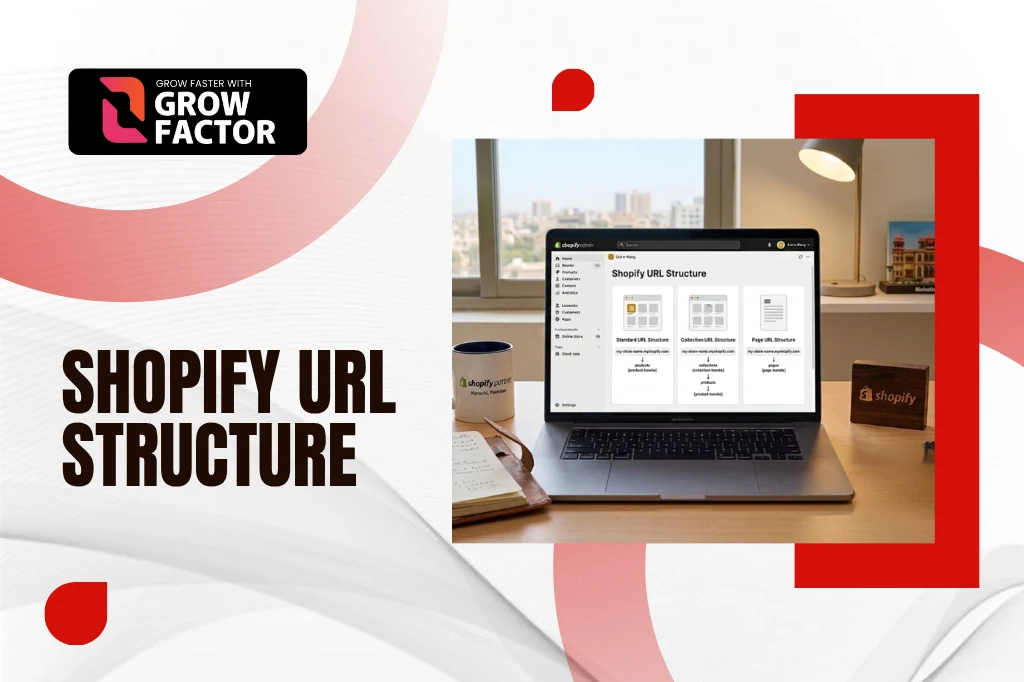
A URL like /collections/all/products/blue-cotton-t-shirt-mens-size-medium-2024 tells Google and buyers almost nothing useful, despite being packed with words. Shopify URL structure done right is short, descriptive, and consistent and it directly affects both rankings and how confidently buyers click through to your pages.
This guide covers Shopify’s default URL structure, how to change it safely, and where most stores get it wrong. It’s written for anyone auditing an existing store’s URLs, not just merchants setting up a brand-new one.
Why does Shopify URL structure matter? Can URL structure affect SEO on Shopify? Yes URLs are a ranking signal, a trust signal for buyers, and the foundation canonical tags and redirects are built on. Getting Shopify URL structure right early avoids painful, risky changes later once a store has scaled.
If you’re a Shopify store owner or SEO specialist working on site architecture, this guide is built the way Growfactor approaches Shopify URL structure for real client stores as part of a broader Shopify SEO strategy, not URL cleanup in isolation.
Want yours reviewed?
See which URLs need optimization and build a cleaner, more search-friendly site structure with a data-driven SEO audit.
Understanding Shopify's default URL structure
Shopify store domain URL format
Every Shopify store gets a yourstore.myshopify.com address by default, though nearly every live store replaces this with a custom domain before launch. Keeping the default domain live as a secondary access point rarely causes SEO issues, since it typically redirects to the custom domain automatically.
Shopify product URL format
Products default to /products/product-handle, where the handle is auto-generated from the product title but fully editable. This is one of the most frequently edited URL types on any active store, since product titles often change after a handle has already been set and indexed.
Shopify collection URL format
Collections use /collections/collection-handle, following the same editable-handle pattern as products. Collection handles tend to be edited less often than product handles simply because collections change less frequently once a store’s catalogue structure is established.
Shopify blog and post URL format
Blog posts follow /blogs/blog-name/post-handle, nesting the individual post under its parent blog. Most stores only run a single blog, which simplifies this structure considerably compared to platforms supporting multiple blogs per site by default.
Is the default Shopify URL structure SEO-friendly?
Mostly, yes. Shopify’s default Shopify URL structure is clean and predictable compared to many platforms, though it isn’t perfect the /products/ and /collections/ prefixes are fixed and can’t be removed, which is a common point of frustration for SEO specialists used to more flexible platforms.
Why you should change your Shopify URL structure
Site redesign or rebranding
A rebrand or major catalogue reorganization is often the natural moment to clean up inconsistent or outdated URL handles across the store. Bundling URL cleanup into a redesign that’s already touching every page reduces the risk of introducing changes piecemeal over time.
Enhancing user experience
Short, descriptive Shopify URL structure choices help buyers understand where a link leads before they even click it, particularly when sharing links directly through WhatsApp, email, or social media rather than clicking through a navigation menu.
Optimizing for SEO
How to improve Shopify URL structure for better rankings usually comes down to trimming unnecessary words, removing stop words, and keeping the primary keyword close to the front of the handle. Small, incremental improvements here compound over a large catalogue in a way that’s easy to underestimate.
How Shopify URL structure impacts SEO and rankings
What is the impact of Shopify URL structure on SEO? URLs are a confirmed, if modest, ranking factor but their bigger impact is often indirect, through click-through rate in search results and through supporting a clean site architecture that crawlers and canonical tags can follow consistently.
How Shopify URL structure supports every stage of the buyer journey
- Awareness: Clean, descriptive URLs appearing in search results build early trust before a click
- Consideration: Logical URL patterns help buyers navigate back and forth between related products and collections
- Decision: A short, memorable URL is easier to share, bookmark, or return to directly at checkout time
How to change your Shopify store's URL structure
Adding a custom domain
Connect a custom domain through Shopify’s domain settings, replacing the default myshopify.com address this is usually the very first URL change any new store makes.
Changing the product URL handle
Edit the handle field directly in the product’s admin page. Changing an established handle after launch always requires a 301 redirect from the old URL to avoid losing existing rankings.
Changing the collection URL handle
Collection handles are edited the same way, directly within the collection’s settings, and carry the same redirect requirement once the collection has been live and indexed.
Changing the blog post slug
Blog post slugs can be edited individually, though changing many at once across an established blog carries meaningful risk to existing rankings if redirects aren’t handled carefully.
Changing URLs for other Shopify pages
Standard pages (About, Contact, policies) use editable handles too, following the same /pages/page-handle pattern as the rest of the store.
Shopify URL structure for specific use cases
Product variants
Shopify URL structure for product variants typically uses a ?variant= query parameter rather than a separate path, keeping variant URLs canonicalized back to the base product by default. This avoids the duplicate content risk that a separate URL path per variant would otherwise create.
Tags
Shopify URL structure for tags generates URLs like /collections/collection-handle/tag-name, which can multiply quickly and deserve monitoring for thin or duplicate content. Stores with heavy tag usage should periodically audit which tag combinations actually get meaningful search traffic versus which exist purely for internal filtering.
Custom domains
Shopify URL structure for custom domains should be finalized before a store scales significantly changing domains later is a far bigger undertaking than changing individual handles, since it affects every single URL on the store simultaneously rather than one page at a time.
International stores
Shopify URL structure for international stores often uses subdirectories or subdomains per market through Shopify Markets, each needing its own consistent handle conventions. Getting this structure right from the start avoids a much more complex migration once multiple markets are live and indexed separately.
Checkout process
Shopify URL structure for checkout process pages is largely fixed by the platform and isn’t meaningfully customizable this is one area where Shopify intentionally limits flexibility for security and consistency reasons, and it’s not worth spending optimization effort trying to change.
Mobile optimization
Shopify URL structure for mobile optimization isn’t about different URLs for mobile versus desktop Shopify serves responsive pages from the same URL, so the focus is simply keeping URLs short enough to display cleanly on smaller screens and in shared links, where a long URL can get awkwardly truncated.
Canonical URLs and Shopify URL structure
Canonical URL for Shopify pages works alongside URL structure to prevent duplicate content Shopify canonical tags automatically point variant and certain duplicate URLs back to one authoritative version. Good Shopify URL canonicalization practice starts with a clean structure in the first place, since fewer structural duplicates means less canonical cleanup work later. This connects closely to broader on-site SEO fundamentals, since URL structure is one piece of a larger on-page technical picture.
What are the risks of changing Shopify URLs?
Impact on SEO rankings
Every URL change without a proper redirect risks losing the ranking signals built up on the old URL this is the single biggest risk in any Shopify URL structure change, and it scales with how long the old URL has been indexed and earning traffic.
User experience considerations
Bookmarked links, saved cart links, and links shared in emails or social posts can all break if a URL changes without a redirect in place. This is a real, if less discussed, cost of poorly managed Shopify URL structure changes one that shows up as customer complaints rather than a ranking drop.
Tips for redirecting old Shopify URLs
Standardizing your URL structure
Decide on a consistent handle convention (lowercase, hyphens, no stop words) before making bulk changes, rather than fixing URLs inconsistently one at a time. A documented convention also makes future product uploads faster and more consistent for whoever’s adding them.
Handling duplicate content in URLs
Combine URL structure cleanup with a canonical tag review, since the two issues frequently overlap on stores with a history of ad-hoc handle changes. A structural fix without a canonical review often just moves the duplication problem rather than resolving it.
Setting up 301 redirects correctly
Every changed URL needs a 301 redirect from the old address to the new one Shopify’s admin includes a built-in URL redirect tool for exactly this purpose, removing the need for third-party redirect apps in most standard cases.
Updating internal links after a URL change
Redirects prevent broken links from working, but don’t fix the extra hop update internal links directly to point at the new URL wherever possible for a cleaner crawl path and a marginally faster page load for visitors following that link.
Common Shopify URL structure mistakes to avoid
- Changing handles without setting up 301 redirects first
- Leaving stop words and filler terms in URL handles unnecessarily
- Inconsistent capitalization or formatting across different sections of the store
- Forgetting to update internal links after a bulk handle change
- Assuming Shopify’s default structure needs no review at all, even at scale
What does it cost to optimize URL structure in Pakistan?
Cost depends on catalogue size and how many existing URLs need redirect mapping. Growfactor’s SEO services in Pakistan start with a free audit so pricing reflects your store’s actual URL structure and history, not a flat package.
What ROI can Shopify URL structure optimization deliver?
Real numbers beat estimates. Growfactor’s fragrance retailer case study included URL structure and redirect cleanup as part of the technical foundation behind growing monthly visitors from 1,100 to 18,400 and organic orders past 420 per month in 8 months.
Should you handle this yourself or hire a Shopify SEO agency?
- DIY works if: your team is comfortable mapping redirects carefully and testing changes before a bulk handle update
- An agency works if: you’d rather a team experienced with Shopify URL structure changes handle the audit and redirect mapping
- Growfactor’s Shopify technical SEO audit services include URL structure review as part of a full technical audit
Ready to Grow Your Shopify Store?
Schedule a free consultation and discover the best opportunities to grow your Shopify store with data-driven SEO.
Frequently Asked Questions
Can you remove /pages/ from Shopify URLs?
No. The /pages/, /products/, and /collections/ prefixes are fixed by Shopify’s platform architecture and can’t be removed without switching platforms entirely.
Can Shopify URL structure be customized?
Yes, to a meaningful degree handles are fully editable, though the underlying prefixes for products, collections, and pages remain fixed.
How do you troubleshoot Shopify URL structure issues?
Use Google Search Console’s Coverage report to spot indexing errors, and audit for missing redirects after any past handle changes.
How do you set up Shopify URL structure correctly?
Decide on a consistent handle convention early, keep handles short and keyword-relevant, and always pair any handle change with a proper 301 redirect.
Conclusion
Shopify URL structure isn’t something to set once at launch and forget it’s worth reviewing periodically as a catalogue grows, especially before any rebrand or major reorganization that risks large-scale handle changes.
Growfactor has audited and optimized Shopify URL structure for 100+ businesses across e-commerce, professional services, and SaaS, over 6+ years of white-hat SEO work in Pakistan and internationally.
Build an SEO-Friendly URL Structure
Discover URL optimization opportunities and improve your store's search visibility with a data-driven Shopify SEO audit.


