
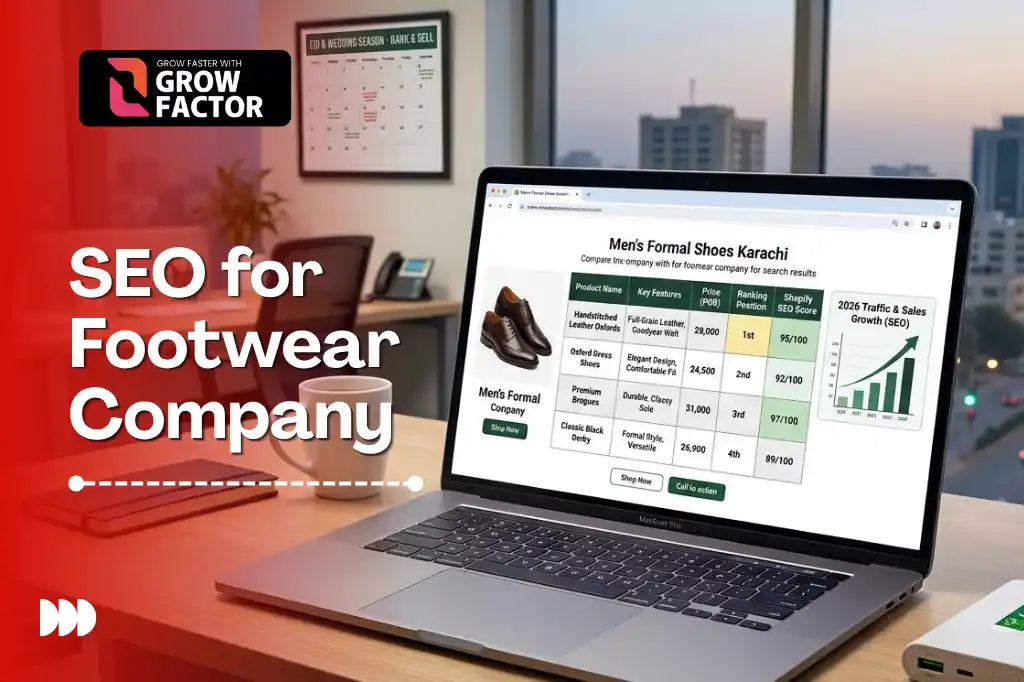
A shopper deciding on wedding shoes doesn’t start with a brand name — they Google “best formal shoes for men Pakistan” and pick from whoever actually shows up. Most Shopify footwear brands never appear in that search at all.
SEO for footwear company websites is the process of optimizing product pages, category structure, and technical performance so a shoe brand ranks for the searches buyers actually type, not just for a brand name loyal customers already know. For brands running on Shopify, this starts with Shopify SEO services built around category and variant structure, not generic storefront fixes.
This guide is written specifically for Pakistani footwear and shoe brand owners running Shopify, not adapted from a Western retail blog. Every tactic here reflects what actually moves rankings for a shoe catalogue in this market.
Footwear is also one of the few retail categories where search demand spikes sharply and predictably around specific calendar events. Which means the SEO calendar for a shoe brand looks meaningfully different from a general fashion or accessories store.
Invisible When Shoppers Search for Shoes?
See exactly which product and category pages are losing traffic to competitors. Get a free footwear SEO audit from our team.
What is SEO for Footwear Companies?
SEO for footwear companies means structuring product, category, and content pages so Google can crawl and rank a catalogue that’s almost always split across dozens of size and colour variants per style — a structural challenge most general SEO advice never addresses.
Most SEO guides are written for categories where one product page equals one product. Footwear rarely works that way, which is exactly why generic e-commerce SEO advice underperforms when applied directly to a shoe catalogue without adjustment.
Done properly, it means a size-9 running shoe search and a size-10 search of the same style don’t compete against each other for the same ranking, and a buyer researching “best shoes for flat feet” lands on genuinely useful content, not a bare product grid.
It also means treating fit and comfort information as core SEO content, not an afterthought — search engines increasingly reward pages that actually answer the buyer’s underlying question, and “will this shoe fit me” is the real question behind most footwear searches.
Why SEO Matters Footwear Brands in Pakistan
E-Commerce SEO as a Long-Term Growth Engine
E-commerce optimization techniques that work for footwear compound over time in a way paid ads never do — a properly optimized product page keeps earning clicks for years after it’s published, without an ongoing budget.
This matters even more in a category where margins get squeezed by high return rates on ill-fitting orders. A page that ranks organically and sets accurate size expectations upfront reduces returns at the same time it reduces acquisition cost.
Channel | Cost pattern | Buying stage covered | Longevity |
|---|---|---|---|
Paid social ads | Recurring, scales with spend | Mostly bottom-funnel | Stops when budget stops |
SEO for footwear company | Upfront investment, low marginal cost | Awareness through purchase | Compounds over months/years |
Seasonality in the Shoe Industry — and Why It Changes Your SEO Calendar
Footwear searches spike hard around Eid, wedding season, and back-to-school — far more sharply than most retail categories. Content and product pages need to be live and indexed weeks before each spike, not during it.
A brand that waits until the week of Eid to publish its collection content is competing for a keyword that’s already saturated. The stores that win these spikes are the ones planning content on a calendar built around search demand, not around when new stock physically arrives.
Why Instagram Ads and Marketplace Listings Alone Aren't Enough
Instagram reach resets with every algorithm change and isn’t indexed by Google at all. A marketplace listing puts a shoe next to five competing sellers on the same page, competing on price alone.
- Neither channel captures the buyer still comparing fit, material, and comfort before purchasing
- Paid reach disappears completely the moment the ad budget stops
- Marketplace listings offer no room for sizing guidance, which is exactly what drives footwear returns
Every rupee spent on either channel produces a spike, not an asset. The moment the spend stops, so does the visibility — which is the opposite of how a properly optimized product page behaves.
How Shoe Buyers Discover and Buy in Pakistan —The 3-Stage Search Funnel
Style and Occasion Searches — Top of Funnel
Awareness-stage buyers search occasions and styles, not products: “formal shoes for wedding Pakistan”, “comfortable shoes for standing all day.” This is where style-guide content earns the first click.
Comparison and Fit Research — Middle of Funnel
Consideration-stage buyers compare specific models and fit: “best running shoes for flat feet”, “leather vs synthetic formal shoes.” This is comparison-content territory, and it’s where sizing confidence gets built.
Ready-to-Buy Product Searches — Bottom of Funnel
Decision-stage buyers search a specific product plus “price” or “buy online”. This is where the product page itself needs clear sizing and return-policy information to close the sale.
Most footwear brands only build content for the bottom stage, treating product pages as the entire strategy. The brands that consistently rank are the ones that also own the awareness and consideration searches happening well before that final click.
Keyword Research for Footwear Products
Mapping Keywords to Category, Occasion, and Size
Layer keyword targeting across category (“men’s formal shoes”), occasion (“wedding shoes for groom”), and size or fit modifiers (“wide-fit sneakers”). Each layer needs its own page, not one generic catalogue page trying to rank for all three.
Long-Tail Keywords for Shoe Buyers — Where the Volume Is
Long-tail, occasion-and-material combinations like “brown leather loafers for office Pakistan” carry far less competition than a generic “buy shoes online” search, and they convert at a noticeably higher rate because the buyer has already self-selected.
Seasonal and Trend-Driven Keyword Planning
Publishing wedding and Eid footwear guides two to three months ahead of the actual season is what captures that traffic — publishing during the peak itself is usually too late to get indexed and ranked in time.
A simple keyword calendar mapped against the last two years of seasonal spikes — Eid, wedding season, winter boots, back-to-school — gives a footwear brand a realistic publishing schedule instead of reactive, last-minute content.
Ready to Capture This Season's Shoe Buyers?
Growfactor maps your catalogue against real seasonal search demand before the next spike hits. Get a free footwear SEO audit today.
On-Page SEO Essentials for Footwear Websites
Product Page Essentials — Sizing, Materials, and Fit Guides
Footwear converts differently from almost every other product category, because the single biggest purchase hesitation — will this actually fit — has to be answered entirely on the page, with no chance to try it on first.
- A clear size chart with both local and international sizing shown side by side
- Material composition and care instructions stated plainly, not buried in a downloadable PDF
- A fit note — true to size, runs narrow, runs wide — since this single detail cuts return requests noticeably
Category Page Optimization
Category pages like “men’s sneakers” or “women’s formal shoes” often outrank individual product pages for broader searches. Growfactor’s guide to Shopify collection page SEO covers exactly how to structure these for a footwear catalogue.
A well-built category page also absorbs a lot of the comparison-stage traffic that would otherwise land on individual product pages and bounce, since it lets a buyer compare several styles without leaving the section.
Structured Data for Products, Offers, and Reviews
Product, Offer, and Review schema unlock star ratings and price snippets directly in Google’s results — a visible trust signal before a shopper even clicks through, which matters heavily in a category buyers are naturally cautious about ordering sight-unseen.
Technical SEO and Mobile Optimization for Footwear E-Commerce
Mobile SEO for Footwear E-Commerce
Mobile SEO for footwear e-commerce matters more than in most categories, since shoe shopping happens heavily on mobile during commutes and breaks. A slow-loading size chart or product gallery loses the sale before the buyer even reaches checkout.
Touch-friendly size selectors and a size chart that doesn’t require pinch-zooming are small details that measurably affect both conversion rate and how long a visitor stays on the page, a signal Google also tracks.
Handling Size and Colour Variant Duplication
Every size and colourway of the same shoe style can generate a separate indexable URL if left unmanaged, splitting ranking signals across near-duplicate pages. A technical SEO audit for Shopify stores identifies exactly which variant URLs need canonical tags.
Site Speed and Core Web Vitals for Image-Heavy Catalogues
Shoe photography from multiple angles adds up fast across a large catalogue. Compressed, properly-sized images and lazy-loading galleries keep Core Web Vitals healthy without sacrificing the visual detail buyers need to trust a fit.
This becomes especially urgent ahead of a seasonal spike, when traffic (and the temptation to add more unoptimized product photos at once) both increase together.
Content Marketing for Footwear Brands
Creating Engaging Content That Ranks
Occasion-based buying guides — wedding shoes, office footwear, running shoe fit guides — consistently outperform generic “about our shoes” blog content, because they match how buyers actually search.
Guides that name specific occasions and outfits also naturally attract the long-tail, high-intent searches that a generic product description never ranks for on its own.
Using Visual Content to Enhance Product Pages
On-foot photography, 360° product views, and short fit videos reduce the uncertainty that drives footwear returns more effectively than text description ever can on its own.
Off-Page SEO and Digital PR for Footwear Brands
Building Quality Backlinks for Your Footwear Company
A handful of links from genuine fashion and lifestyle publications carries more ranking weight than dozens of low-quality directory links, and it builds real brand credibility at the same time.
This kind of link takes longer to earn than a directory submission, which is exactly why it should start early — a link built this quarter can still be lifting rankings two or three seasons from now.
Influencer Marketing and Social Mentions as Link Signals
Influencer content itself isn’t indexed by Google, but the coverage and mentions it generates on blogs and press sites often are. That’s the SEO value hiding inside an influencer campaign that most footwear brands never actually track.
Local SEO Strategies for Footwear Retailers
Optimizing Google Business Profile for Your Footwear Store
Brands with a physical store or kiosk should treat Google Business Profile as a dedicated workstream. Growfactor’s local SEO services for retail stores cover claiming, review management, and citation building for exactly this.
Generating Local Reviews and Citations
Consistent review collection directly affects local pack ranking, and a simple post-delivery WhatsApp request — sent while the purchase is still fresh — outperforms a generic follow-up email sent days later.
Listing on Pakistani fashion and retail directories with a consistent name, address, and phone number across every listing also reinforces the same trust signals Google checks for local ranking.
Common SEO Mistakes Footwear Companies Make
Most of these mistakes stay invisible to a normal site visitor — the catalogue still looks fine. It’s Google’s crawlers and comparison-stage buyers who notice the gaps first.
An audit almost always surfaces at least three or four of these at once, since they tend to compound — thin descriptions and missing size charts, for instance, usually show up together on the same catalogue.
- Publishing the same generic description across every size and colourway of a shoe style
- No size chart or fit guidance, pushing buyers to ask on WhatsApp instead of converting on the page
- No schema markup, missing out on star ratings and price snippets competitors already show
- Treating the blog as an afterthought instead of the primary channel for occasion-based searches
- Ignoring Core Web Vitals on image-heavy product galleries, especially ahead of seasonal spikes
- No Google Business Profile despite operating a physical store or kiosk
How Much Does SEO Cost for a Footwear Company in Pakistan?
Pricing tends to track catalogue complexity more than raw product count — a 50-style catalogue with heavy size and colour variants can need more technical work than a 200-style catalogue with simpler variant structures.
Pricing depends on catalogue size and how much technical cleanup is needed upfront. Ongoing SEO for footwear company retainers for a mid-size Pakistani brand typically fall in the PKR 80,000–220,000 per month range, with a larger one-time audit fee for catalogues that haven’t had structural SEO work done before. Full pricing tiers are on Growfactor’s SEO pricing in Pakistan page.
What to Look for in an SEO Agency for Footwear Brands
Ask for a specific plan on variant duplication and sizing schema, not just a general promise to “write better content” — footwear’s technical challenges are specific enough that a vague answer here is a warning sign.
Confirm the agency can show documented e-commerce results, not just keyword-ranking screenshots. A free SEO audit before signing anything is the fastest way to see whether an agency’s claims hold up against your actual catalogue.
Growfactor has scaled 100+ companies across e-commerce, professional services, and SaaS over 6+ years of white-hat SEO in Pakistan and internationally. Full details are on the Growfactor SEO services in Pakistan page.
Done with SEO? Here's How to Convert the Traffic You've Earned
Ranking traffic that bounces without converting is a wasted opportunity. Clear sizing information, visible return policies, and fast checkout are what turn a well-ranked product page into an actual order.
- Show delivery timelines and return policy directly on the product page, not buried in a footer link
- Add a size-exchange guarantee where possible — it directly addresses footwear’s biggest purchase hesitation
- Keep checkout to as few steps as possible on mobile, where most footwear traffic actually converts
Frequently Asked Questions
Is It Worth Investing in SEO for Footwear Company?
Yes — footwear has strong, predictable seasonal search demand, and organic traffic converts especially well once sizing and fit information is handled properly on the product page.
What to Remember When Doing SEO for an Online Shoe Store?
Prioritize fixing size and colour variant duplication before expanding content — a technically broken catalogue won’t rank no matter how good the writing is.
How Important Is Site Speed for Shopify Footwear SEO?
Very — footwear shopping happens heavily on mobile, and a slow-loading product gallery or size chart loses the sale before checkout even begins.
Is Blogging Still Worth It for Footwear E-Commerce?
Yes, particularly occasion-based buying guides, which consistently outperform generic brand content because they match how buyers actually search.
How Do I Track Whether My SEO Is Driving Sales?
Track organic conversion rate and revenue by category in Google Analytics 4, not just traffic or keyword rankings alone, since those are the numbers that tie back to the business.
Conclusion
A shoe store’s foot traffic depends on its location and footfall. A product page built correctly today can still be generating organic orders two years from now, from anywhere in the country — that’s the asset SEO for footwear company websites actually builds.
The brands that treat this as a one-time project rather than an ongoing practice are the ones that plateau right after the first seasonal spike, just as the compounding effect was about to start paying off.
Get your Free Footwear SEO SEO Audit
Growfactor will map exactly which product, category, and content pages are losing traffic — and where the fastest wins are for your specific catalogue.
Your Free Audit Is Ready
Find out exactly what’s holding your footwear brand back from page one. Book a free SEO audit with Growfactor’s team.


