
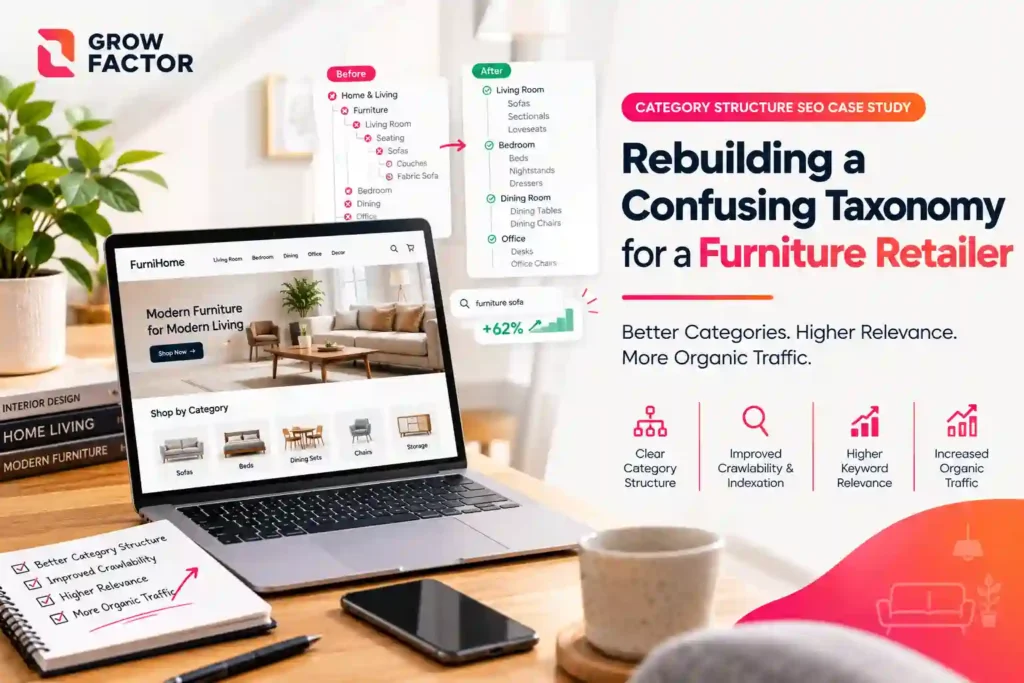
A furniture retailer’s catalogue had grown for years without anyone revisiting how it was organized. Filters for material, room, color, and size had each quietly generated their own indexable URL, on top of an already fragmented category tree.
Instead of a handful of strong category pages collecting search demand, the site had hundreds of thin, overlapping ones, most of them competing with each other instead of with competitors.
A category structure fix means consolidating a flat or over-fragmented taxonomy, and controlling which filter combinations get indexed, so search authority collects on a smaller set of strong category pages instead of splitting across hundreds of thin ones. For a campaign like this, typical results are indexed page count dropping 40% to 70% while category page rankings improve within 2 to 4 months (illustrative range, not a specific client’s result).
The Background: A Catalogue That Outgrew Its Own Structure
The taxonomy had been built early on and never revisited as the catalogue grew. New filters kept getting added, and each one created more indexable combinations without anyone checking whether Google should be crawling them at all.
Auditing the Existing Taxonomy and Indexed Filter Combinations
We mapped the full category tree and cross-referenced it against Google's index to see which filter-generated URLs were actually being crawled and indexed, versus which should have been blocked or canonicalized from the start.
Consolidating Categories Around Real Search Demand
We rebuilt the taxonomy around how buyers actually search, by room and by primary material, rather than every possible filter combination, and controlled faceted navigation so only genuinely useful combinations stayed indexable. This follows Google’s own guidance on faceted navigation, which is specific about how uncontrolled filters waste crawl budget and dilute ranking signals.
We’ve fixed this same structural problem for 100+ businesses across e-commerce, professional services, and SaaS, all on 6+ years of white-hat SEO. If your catalogue has grown faster than its category structure, on-page optimization services is where that gets untangled.
Rebuilding Internal Links Around the New Structure
Navigation, breadcrumbs, and cross-links were updated to point at the consolidated categories instead of the fragmented ones they replaced, so the authority gained from the new structure flowed to the pages meant to rank, not to pages scheduled for removal.
The Real Change: from Hundreds of Thin Pages to a Handful of Strong Ones
Before, a search for a specific furniture type could surface several of the retailer's own thin, overlapping category pages, none of them dominant. After, one clear category page consistently ranked, carrying the authority that used to be spread across a dozen near-duplicates.
The Business Outcome
Category pages that had stagnated for months started moving once the structure stopped working against them. Crawl budget that used to be spent on filter combinations nobody searched for went toward the categories that actually drive revenue.
Why This Approach Worked
A search engine can only concentrate ranking authority where the structure lets it. Spreading the same demand across hundreds of near-identical category URLs guarantees none of them ranks as well as one consolidated page would.
Final Results at a Glance
- Indexed page count: typically reduced by 40% to 70%
- Category page rankings: typically improve by 5 to 15 positions within 2 to 4 months
- Organic traffic to category pages: typically a 20% to 50% increase
- Crawl budget freed up: typically 30% to 55% fewer redundant pages crawled per cycle
- Category page conversion rate: typically improves by 8% to 18%
What This Means for Similar Businesses
If your catalogue has grown through filters and subcategories added one at a time, your structure may be splitting rankings you could otherwise consolidate. At Growfactor, this is the same on-page optimization services approach we bring to any catalogue whose taxonomy never caught up with its growth.
Growfactor consolidates your category structure so authority concentrates on the pages that convert, not hundreds of thin ones. Get a free audit today.
For a look at what a different local fix did for another business, see our client results.

