
Two Shopify storefronts, one brand, and Google could not tell them apart. Here is how the UAE store went from invisible to its own market’s first choice.
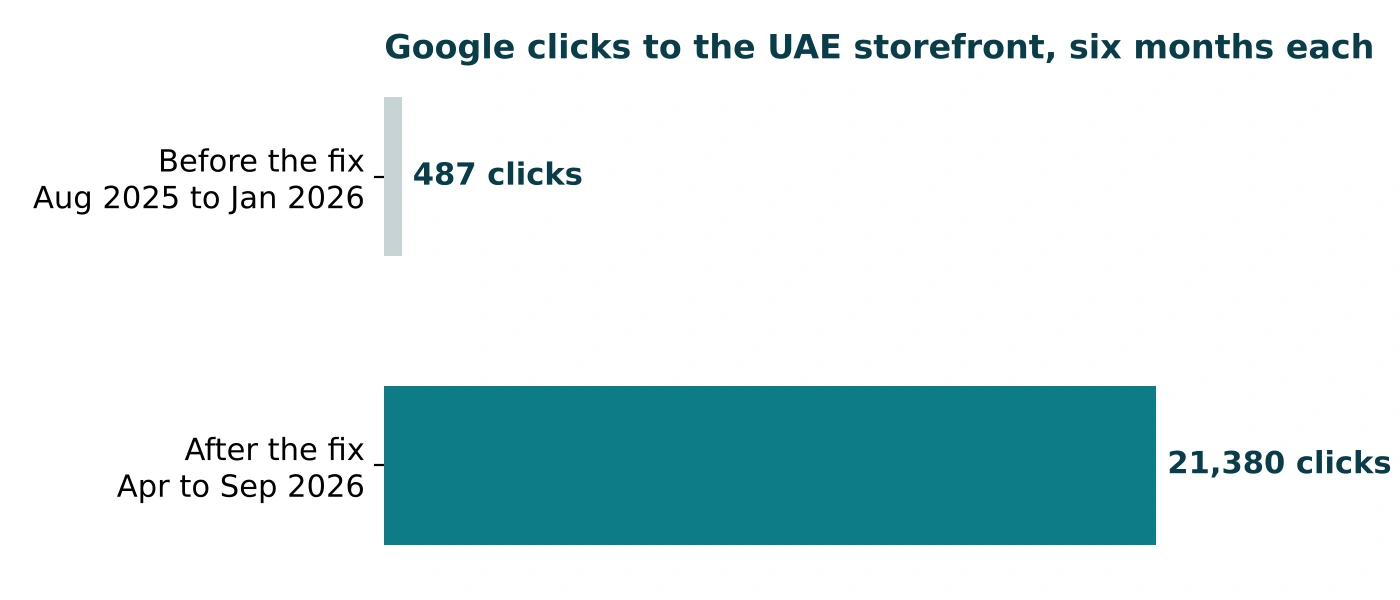
more Google clicks, 487 to 21,380 in six months
more impressions, 5,380 to 1.77 million
clicks in the best month, up from 151
UAE click-through rate, the store’s top market
The Case File
| Client | Fragrance brand selling through two Shopify storefronts |
| Markets | Pakistan (established store) and the United Arab Emirates (newer store), plus a retired UAE domain |
| Core issue | Duplicate content across domains with no hreflang, so the stores competed for the same searches |
| Services | Technical SEO, Shopify SEO, market-specific content, structure and brand consistency |
| Timeline | Work from September 2025, measured 21 August 2025 to October 2026 in Google Search Console |
Your second storefront can sell to a whole new country and still lose its searches to your first. For this brand, UAE shoppers searched for its perfumes, and Google kept sending them to the wrong site.
Cross-domain SEO makes two or more websites under one brand rank side by side instead of against each other. It uses hreflang tags, canonical rules, redirects and market-specific content to tell Google which domain serves which country, so every shopper lands on the right store.
The Challenge: Two Stores Fighting for One Search
The brand built its name in Pakistan, then opened a UAE storefront to serve shoppers in the Emirates. The UAE store launched as a near-identical copy of the original, the fastest way to open in a new country.
Google saw two near-identical sites and picked one to show. It usually picked the older Pakistan store, so in its first six months, the UAE store earned just 487 clicks from 5,380 impressions.
151
Google clicks in the UAE store’s best month before the fix. Six months later, it earned 5,404 in a single month.
Five Problems, Five Fixes
The audit traced the conflict to five separate causes. Each needed its own fix, and the order mattered: search signals first, content second.
Issue 1 The Wrong Store Was Ranking
THE PROBLEM
The Pakistan storefront ranked for the UAE storefront’s product pages, so UAE shoppers landed on a store with the wrong prices and delivery.
THE FIX
Mapped every product, collection and key page across both stores, then added hreflang pairs so each page declares its country and points to its sibling.
What changed: UAE searches now lead to the UAE store, which became its own top market with 5,288 clicks.
Issue 2 Copies, Not Market Pages
THE PROBLEM
Product descriptions and page titles were nearly identical across both domains, giving Google no reason to treat the UAE pages as distinct.
THE FIX
Rewrote UAE product and collection pages around AED pricing, UAE delivery and local availability, and set canonical rules so each page points to itself.
What changed: 45 UAE product pages and 15 collections now earn clicks of their own.
Issue 3 A Retired Domain Still in the Index
THE PROBLEM
The old UAE domain redirected to the new store, but its stale pages stayed indexed and kept competing for the brand’s searches.
THE FIX
Built a page-level redirect map from the retired domain and cleared its stale pages from Google’s index.
What changed: Old URLs now pass their value to the new store instead of splitting it.
Issue 4 One Brand, Two Names
THE PROBLEM
The brand traded under two names across its stores, and shoppers searched dozens of spellings. Search signals were divided between them.
THE FIX
Used one consistent brand name across titles, headers and structured data on the UAE store.
What changed: Exact brand searches now click at 28.5%, a strong base to pull the variants toward.
Issue 5 No Clear Route to the Products
THE PROBLEM
Even when UAE shoppers arrived, the menu and internal links did little to move them toward collections and products.
THE FIX
Rebuilt the menu, aligned collections to how shoppers search and replaced vague links with descriptive anchors.
What changed: 61 UAE shopping pages now earn Google clicks, 5,878 between them.
Hreflang, canonicals, and redirects are core technical SEO foundation work, and they decide whether a second storefront can rank at all. Growfactor handles both stores together through our Shopify SEO services.
The standard behind the fix comes from Google’s guidance on telling Google about localized versions of your page.
| When | What Went Live |
|---|---|
| Sep 2025 | Cross-domain audit and duplicate map across both stores and the retired domain |
| Oct 2025 | Hreflang pairs and canonical rules on both storefronts |
| Nov 2025 | Retired domain redirect map and stale page removals |
| Dec 2025 | UAE-specific rewrites of product and collection pages |
| Jan 2026 | Menu, collections, internal links and brand consistency |
| Feb 2026 on | UAE content calendar, and the first clear rise in clicks |
Clicks began rising in February 2026, about four months after hreflang went live. That gap is normal: Google has to recrawl both sites and settle on which version to show in each country.
Are your storefronts competing with each other?
We took this UAE store from 487 to 21,380 clicks in six-month terms. Get a free SEO audit to see where yours stand.
| Before the Fix | After the Fix | |
|---|---|---|
| Google clicks (6 months) | 487 | 21,380 |
| Impressions (6 months) | 5,380 | 1,766,647 |
| Best month | 151 clicks | 5,404 clicks |
| Who ranked for UAE products | The Pakistan store | The UAE store |
| Hreflang between stores | None | Every mapped page |
| Retired UAE domain | Stale pages indexed | Redirected page by page |
Almost nothing while the stores competed, then a sharp step once Google sorted them into their markets. Across 16 months, the UAE store earned 24.9k clicks and 2.06 million impressions at an average position of 7.3.

Behind the headline growth, four findings show the cross-domain fix working where it matters most.
5,288
The UAE store’s biggest source of clicks is the country it was built for, at a 2.19% click-through rate, more than double any other market.
61
45 product pages, 15 collections and the homepage earned 5,878 clicks, ranking in place of their Pakistan copies.
28.5%
Shoppers who search the brand name precisely click more than a quarter of the time, a base the brand consistency work builds on.
1,676
Review and product snippets earned clicks at 2.61% and 2.14%, roughly double the 1.2% site average.


he demand behind these numbers is still growing. UAE and Dubai searches alone earned 18,989 and 8,882 impressions, and the content calendar is now built around winning more of them.
If you run more than one storefront, these are the checks that would have saved this brand months of lost UAE sales.
With the conflict resolved, the focus moves from fixing signals to winning more UAE demand.
These are the questions multi-store brands ask us before starting a cross-domain fix.
When two of your sites carry near-identical pages, Google treats them as duplicates and picks one to show. Without hreflang, it often picks the older domain, which is why this brand’s Pakistan store outranked its UAE store in the Emirates.
Hreflang tells Google which version belongs to which country, but it works best when the pages are genuinely different. That is why this project paired hreflang with UAE-specific pricing, delivery and availability.
In this case, clicks began rising about four months after hreflang went live and peaked nine months after the first fix. Google needs time to recrawl both sites and settle on the right version for each market.
One Brand, Every Market, the Right Store
We find where your search traffic stops short of your product pages, then fix the menu, links and brand signals that connect them.