
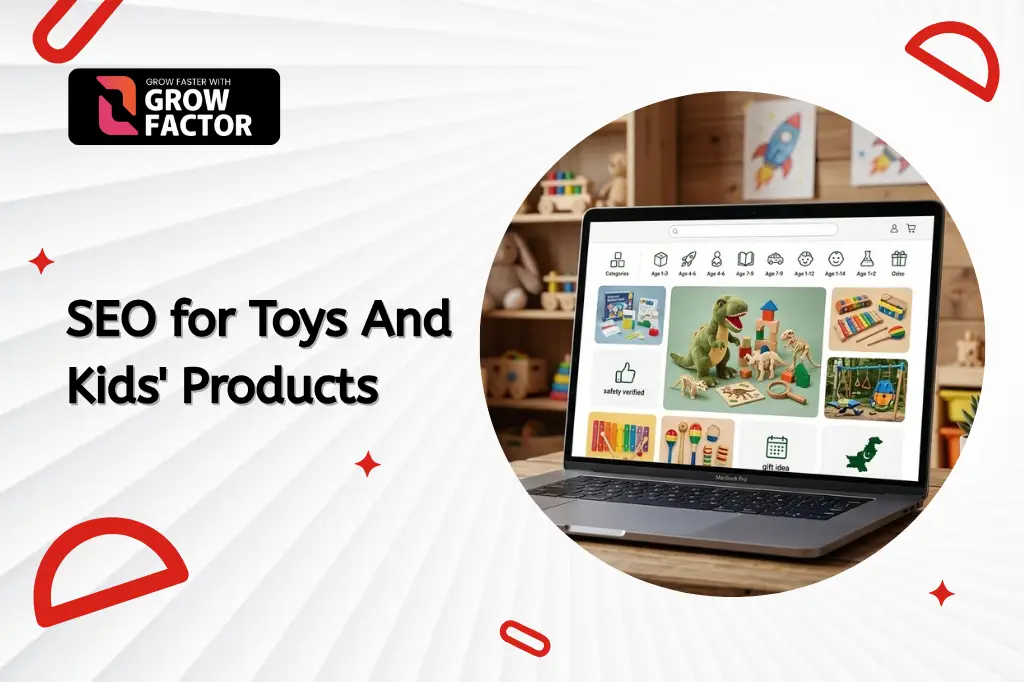
A parent shopping for a five-year-old’s birthday doesn’t search a toy name. They type “best gift for 5 year old boy who likes dinosaurs” and choose from whichever store actually answers that question.
That’s the whole premise behind SEO for toys and kids’ products: ranking for how parents actually think through a purchase age, stage, interest, safety rather than waiting for them to already know which product to search for by name.
Toys carry a mix of pressures few other categories deal with at once: a short window before the child ages out of a product, a parent who won’t buy anything that feels unsafe, and search platforms that treat content aimed at children with real caution. This guide is built around all three, for Pakistani sellers on Shopify.
Getting all three right at once is what separates a catalogue that ranks briefly for a trending toy from one that keeps earning traffic across every age cohort that comes after it.
Invisible When Parents Search by Age or Interest?
See exactly which product and category pages are losing traffic to bigger toy retailers. Get a free SEO audit from our team.
What Is SEO for Toys and Kids' Products?
SEO for toys and kids’ products means structuring product pages, categories, and content around how a parent actually searches by age, developmental stage, interest, and safety concern rather than by toy name alone.
A catalogue organized purely by toy type (blocks, dolls, puzzles) misses the way most parents actually shop. Which is closer to “what does a 4-year-old need right now” than “show me every puzzle you sell.”
Thinking Like a Parent First, Search Engines Second
A parent isn’t researching a toy the way they’d research a phone. They’re really asking, “Will this be right for my child?” and every page on the site should be built to answer that underlying question first.
Content written to satisfy that underlying question tends to satisfy Google’s ranking systems too, since both are ultimately looking for the same thing: a genuinely useful answer to a real concern.
Why SEO Matters for Toy and Kids' Product Stores in Pakistan
The Growth Logic Behind Fast-Scaling Baby and Child Brands
The toy and kids’ product brands that scale fastest tend to rank early for age-and-interest searches. Then keep compounding that visibility as each new age cohort of parents starts searching the same terms their predecessors did.
| Channel | Cost pattern | Trust signal | Longevity |
|---|---|---|---|
| Paid social ads | Recurring, scales with spend | Lower — flagged as sponsored | Stops when budget stops |
| SEO for toys and kids' products | Upfront investment, low marginal cost | Higher — organic, parent-vetted | Compounds over months/years |
Why Paid Ads Alone Aren't Enough for Kids' Products
If your toy or kids’ product store runs on Shopify, Shopify SEO services close this trust gap: product pages built to rank organically reach cautious first-time parents before a competitor’s paid ad does.
That combination makes organic trust-building content disproportionately valuable here: it reassures a cautious new buyer at the exact volume a short product lifecycle demands.
Short Customer Lifecycles and a High Parental Trust Barrier
A child outgrows most toy categories within a year or two. This means a brand is constantly acquiring new customers rather than simply retaining old ones and a first-time parent buyer is unusually cautious before trusting an unfamiliar store.
That combination makes organic trust-building content disproportionately valuable here: it does the work of reassuring a cautious new buyer at exactly the volume a short product lifecycle demands.
Navigating Strict Ad Policy Around Marketing to Children
Major ad platforms apply extra restrictions to content aimed at or likely to reach children. This limits targeting options paid campaigns can normally rely on. Organic search doesn’t carry that same constraint, making it a more reliable long-term channel here than in most retail categories.
A brand that leans too heavily on paid reach in this category is effectively building on the least stable ground available to it. The platform rules alone can shift the economics of a paid campaign overnight.
Visibility Friction in the AI Answer Engine Era
AI answer engines are cautious about surfacing commercial content aimed at children without clear, well-sourced context. This rewards stores that publish genuinely informative, well-structured content over ones relying purely on product listings.
This friction will likely increase rather than ease over time, which makes building genuinely trustworthy content now a better long-term bet than waiting to see how the trend settles.
How Parents Discover and Buy Toys in Pakistan : The 3-Stage Search Funnel
Top of Funnel : Age, Stage, and Development Questions
Awareness-stage parents search development questions, not products: “best toys for fine motor skills”, “what should a 2-year-old be playing with.” This is where genuinely useful content earns the first click.
Middle of Funnel : Comparison and Safety Research
Consideration-stage parents compare specific products and safety details: “wooden vs plastic toys for toddlers”, “safe paint on baby toys.” This is comparison-content territory, and it’s where trust actually gets built.
Bottom of Funnel : Ready-to-Buy Product Searches
Decision-stage parents search a specific product plus “price” or “buy online Pakistan”. This is where the product page needs to confirm age suitability and safety instantly, with no hesitation left.
Most stores build almost their entire catalogue around this final stage alone. The stores that actually compound their traffic are the ones also owning the development and safety-research searches happening days or weeks earlier.
Ready to Rank for Every Age and Stage?
Growfactor maps your catalogue against real parent search demand by age, interest, and concern. Get a free audit today.
Modern Keyword and Topic Strategy for Toy Stores
From Keywords to Topics
A single keyword like “educational toys” is too broad to build a page around. Organizing content into topic clusters by age band, skill developed, and interest produces a far more realistic content plan than a flat keyword list.
Question-Based SEO for Parents
Parents phrase toy research as genuine questions far more than in most retail categories. Building content that directly answers those questions earns both search visibility and the kind of trust a product listing alone can’t.
Long-Tail Keywords for Toys That Actually Sell
Long-tail keywords for toys, age, interest, and material combinations like “wooden puzzle toys for 3 year olds Pakistan” carry far less competition than a generic “buy toys online” search, and convert noticeably better.
These combinations also tend to stay useful across multiple years, since the same age-and-interest pattern repeats with every new cohort of parents searching for their own child’s current stage.
Owning Brand and Product Name Searches
Once a specific toy line gains recognition, buyers start searching it by name. A store that hasn’t built dedicated pages for those exact names loses easy, high-intent traffic to whichever competitor did.
Product, Category, and Faceted SEO That Actually Drives Sales
Product Pages : From Catalogue to Advisor
A strong toy product page does more than list specs; it tells a parent who the toy is genuinely right for, which is the actual decision most listings never actually help them make.
Handling Variants : One URL or Many
Colour and size variants of the same toy should generally sit on one canonical page rather than splitting into separate indexable URLs. Growfactor’s guide to Shopify product variant URL SEO covers exactly how to structure this correctly.
Image and Video SEO for Toy Products
Descriptively named, compressed images and short in-use videos help a parent judge scale and safety at a glance details a text description alone struggles to communicate convincingly.
Smart Category Structure and Faceted Navigation
Filtering by age, skill, and interest should sit above filtering by brand or price, since that’s the order most parents actually think in when browsing rather than searching directly.
Cart and Checkout : Where SEO Gains Are Won or Lost
Ranking traffic that abandons at checkout is a wasted investment. Clear age-safety confirmation and visible return policy directly on the product page carry that traffic through to an actual order.
All the work that goes into SEO for toys and kids’ products up to this point gets wasted if the final checkout step introduces friction a cautious parent wasn’t expecting.
Technical SEO, Core Web Vitals, and Structured Data
Core Web Vitals for Image-Heavy Toy Stores
Toy catalogues lean heavily on photography and video, which makes page weight a constant risk. Growfactor’s Shopify Core Web Vitals guide walks through the fixes that keep image-heavy pages fast.
Mobile-First Reality and JavaScript Rendering
Most parent research happens on mobile, often while a child is nearby demanding attention. Heavy, poorly-optimized JavaScript.
The exact problem covered in our Shopify JavaScript guide delays rendering and costs the sale before the page even finishes loading.
Structured Data and How to Test Your Schema
Product, Review, and Age Range schema help Google understand exactly who a toy is suitable for. Google’s own Rich Results Test is the fastest way to confirm that schema is implemented correctly before it goes live.
Handling Out-of-Stock and Discontinued Toys
Toy inventory turns over fast, especially around trend cycles. Managing discontinued listings with proper redirects, rather than leaving them live and indexed, protects the rankings the rest of the catalogue has already earned.
A quarterly review of the catalogue against actual stock status catches this before it quietly erodes the trust a parent placed in the site the last time they visited a now-broken page.
Content , E-E-A-T, and AI Search for Toy Brands
Building E-E-A-T for a Toy Store
Author bylines from people with genuine early-childhood or safety expertise, cited sources, and clear editorial standards all signal the kind of trustworthiness search engines weigh heavily for content aimed at children.
Privacy and Child-Related Content Rules
Content and data practices involving children carry real legal and platform scrutiny. Collecting minimal data, avoiding content that directly targets children as the audience for marketing messages, and being transparent about practices all matter here more than in general retail.
Building this discipline in from the start is considerably easier than retrofitting it later, once a catalogue and content library have already grown around less careful habits.
From Blog to Content System
A handful of scattered blog posts rarely compounds. A structured content system organized by age band and topic, updated on a schedule, is what actually builds lasting search visibility.
Seasonal and Event-Based Buying Guides
Birthday season, Eid, and back-to-school each create predictable search spikes. Publishing age-and-occasion buying guides two to three months ahead of each is what actually captures that traffic.
Optimizing for AI-Generated Answers
Clearly structured, well-sourced buying guides are what AI Overviews and conversational tools pull from when answering a parent’s question directly; product listings alone rarely qualify for that visibility.
Local SEO and Omnichannel Discovery for Toy Stores
Stores with a physical location should treat Google Business Profile as a dedicated workstream. A children’s toy store near me search carries strong same-day intent, especially close to a birthday. Growfactor’s local SEO services cover claiming, review management, and citation building for exactly this.
Common SEO Mistakes Toy and Kids' Product Stores Make
Most of these mistakes look harmless to a browsing parent. The catalogue still looks fine. It’s Google’s crawlers and safety-conscious buyers who notice the gaps first.
An audit almost always surfaces several of these together, since missing age information and thin variant descriptions tend to be symptoms of the same underlying gap in how the catalogue was originally built.
- Publishing the same generic description across every colour or size variant of a toy
- Leaving out age-range and safety information that parents actively search for before buying
- No schema markup, missing out on age-range and review snippets competitors already show
- Treating the blog as an afterthought instead of the primary channel for development and safety questions
- No Google Business Profile despite operating a physical store
- Ignoring Core Web Vitals on image and video-heavy product pages
How Much Does SEO Cost for a Toy Store in Pakistan?
Costs scale mainly with how much age-and-safety content needs to be built from scratch, more than with raw product count. A smaller catalogue with thin, generic descriptions can need more work than a larger, well-documented one.
Pricing depends on catalogue size and how much age-and-safety content needs building from scratch. Ongoing SEO for toys and kids’ products retainers for a mid-size Pakistani catalogue typically fall in the PKR 80,000–220,000 per month range. Full pricing tiers are on Growfactor’s SEO pricing in Pakistan page.
What to Look for in an SEO Agency for Toy and Kids' Product Brands
A strong fit will raise privacy and child-directed content considerations before you even ask about it. That’s usually the clearest sign they’ve genuinely worked with SEO for toys and kids’ products before, not just general e-commerce.
Ask how the agency plans to handle content aimed at a child-adjacent audience specifically. A vague answer is a warning sign, since the privacy and trust considerations here are genuinely different from general retail. A free SEO audit before signing anything is the fastest way to see whether an agency’s claims hold up against your actual catalogue.
This agency’s track record spans 100-plus businesses in e-commerce, professional services, and SaaS, built over six-plus years of white-hat SEO across Pakistan and abroad. The full picture is on the Growfactor SEO services in Pakistan page.
A Practical 6-Month SEO Roadmap for a Toy Store
Months 1–2 — Fix the Foundations
Run a full technical and content audit, fix variant duplication and schema gaps, and confirm every age-range detail is accurate and visible on the product pages that need it most.
Months 3–4 — Build Authority and Trust
Publish the first wave of age-and-topic content, establish author credibility signals, and begin outreach for genuine backlinks from parenting and education-focused sites.
Months 5–6 — Amplify and Refine
Expand into seasonal and event-based content, refine underperforming pages using real search data, and scale the content system that’s already showing traction.
Modern Analytics for Toy Store SEO
Tracking traffic by age band, not just overall sessions, is what turns a generic analytics dashboard into one that actually reflects how this catalogue gets searched and bought.
| KPI | What It Measures | Where to Track It |
|---|---|---|
| Organic traffic by collection | Which styles or categories are gaining visibility | Google Analytics 4 |
| Keyword rank movement | Progress on target style and occasion terms | Rank tracking tool |
| Organic conversion rate | Whether traffic is converting to orders | GA4 + Shopify |
| Shopping surface impressions | Whether GTIN-linked listings are showing up correctly | Google Merchant Center |
Frequently Asked Questions
What Are the Common SEO Mistakes for Toy Retailers?
Missing age and safety information, thin variant descriptions, and no structured data are the three most frequent and most fixable issues found in a typical audit.
What Keywords Should I Use for Children's Toy SEO?
Prioritize age, developmental stage, and interest combinations over generic category terms; that’s where genuine parent search intent actually concentrates.
How Is SEO Different for Toys and Electronics?
Toy SEO leans far more heavily on trust, age-appropriateness, and question-based content, while electronics SEO leans more on spec comparison and technical detail.
Why Do Parents Search for a “Children's Toy Store Near Me”?
Usually an urgent gift need a birthday party the same day or the next. Strong local SEO captures this same-day intent that pure e-commerce SEO never reaches.
What Challenges Exist in SEO for Children's Products?
Usually an urgent gift need: a birthday party the same day or the next. Strong local SEO captures this same-day intent that pure e-commerce SEO never reaches.
Conclusion and Next Steps
A toy displayed on a shelf only reaches whoever walks past it. A properly optimized page keeps answering the same age-and-interest question for every new parent who searches it; that durability is what SEO for toys and kids’ products is actually worth.
The stores that treat this as ongoing upkeep rather than a one-time project are the ones still capturing that search a year from now, for a completely new cohort of parents asking the same questions.
Get Your Free Toy Store SEO Audit
Growfactor will map exactly which product, category, and content pages are losing traffic and where the fastest wins are for your specific catalogue.
A short audit call is usually enough to surface the two or three fixes worth tackling first.
Get Your Catalogue Reviewed Free
See precisely what’s keeping your toy store off page one. Book a free SEO audit with Growfactor’s team.


